
What World Cup Water Breaks Taught Travel Advertisers About Live Sports Attention
The 2026 FIFA World Cup gave travel advertisers plenty to study.
The obvious lessons were about scale, sports tourism, international visitation, and the long tail of post-event travel. But one of the more interesting advertising lessons came from something much smaller inside the match experience: water breaks.
For the 2026 tournament, FIFA introduced mandatory three-minute hydration breaks midway through each half of every match. The original reason was player welfare, especially with the tournament being played across North America during the summer. But from a media and advertising perspective, the impact was bigger than hydration.
Those breaks created more advertising opportunities and more natural attention windows inside a live sports environment.
That is the part travel advertisers should be paying attention to.
According to Reuters, the World Cup final between Spain and Argentina drew nearly 63 million U.S. viewers across Fox, Telemundo, and Peacock. Reuters also reported that mandatory hydration breaks split matches into four segments and created additional advertising opportunities, with Fox expected to generate at least $250 million from hydration-break advertising alone.
That is not just a broadcast story. It is a performance marketing signal.
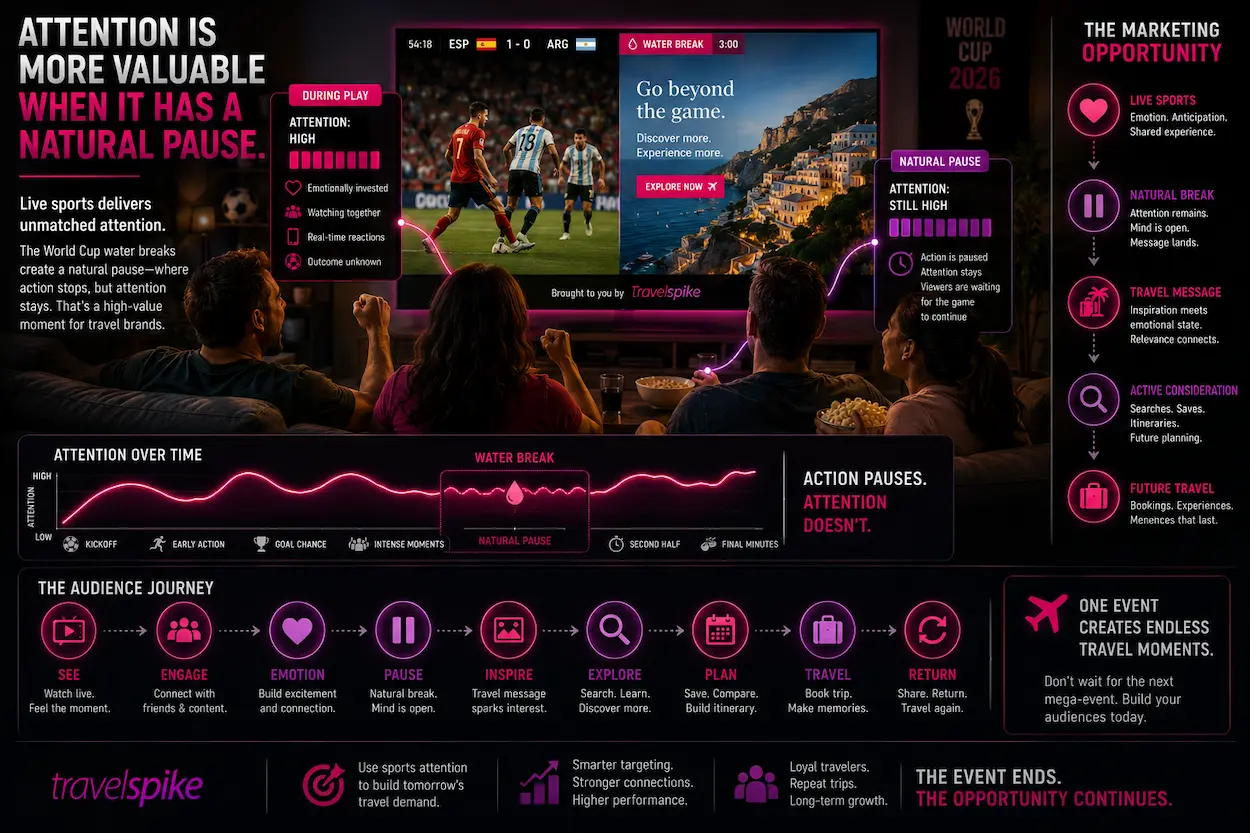
Attention Is More Valuable When It Has a Natural Pause
Live sports already creates a different type of audience attention than most digital media.
Viewers are not casually scrolling past. They are emotionally invested, watching in real time, reacting with friends, checking scores, following storylines, and staying connected because the outcome is unknown. That kind of attention is rare.
The World Cup water breaks added something else: a natural pause.
Instead of forcing an ad into a low-attention environment, the break created a moment where the viewer’s attention was still attached to the event, but the action had temporarily stopped. That is a valuable space for advertisers because the audience is not leaving the experience. They are waiting for the game to continue.
For travel brands, that matters.
Travel advertising performs best when the message connects to an emotional state. Live sports creates emotion. A natural break creates room for the message. Together, they create a stronger chance to move someone from passive awareness to active consideration.
The Performance Lesson Is Timing
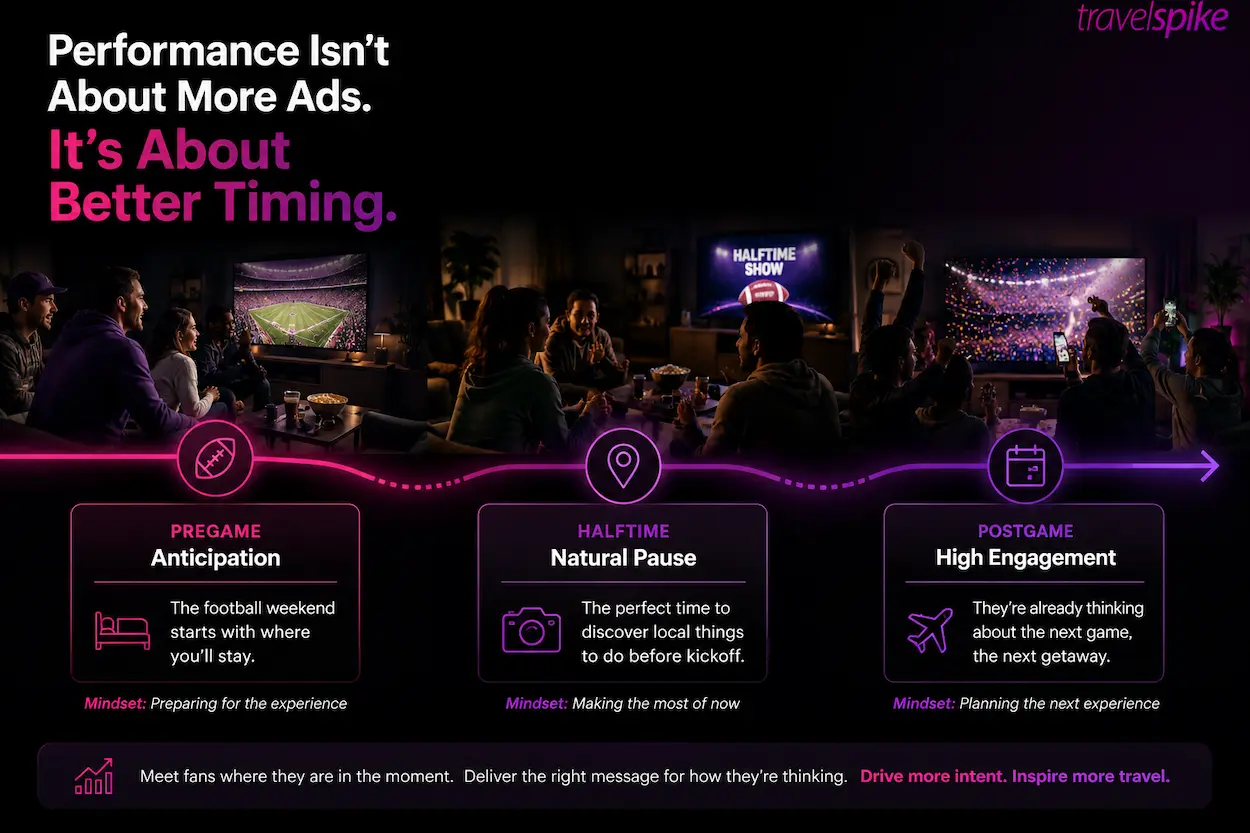
The water break lesson is not simply “more ad slots are good.” More inventory only matters if the timing, context, and message are right.
A travel brand appearing during a high-attention sports moment should not treat the placement like generic awareness. The goal should be to connect the viewer’s current mindset to a future travel action.
During the World Cup, that could have meant messaging around summer trips, international travel, city exploration, sports travel, group getaways, or post-event extensions. As we move into fall sports, the same logic applies to NFL and college football.
The audience is already gathering around a shared moment. The advertiser’s job is to make the travel message feel connected to that moment.
That could be a hotel brand promoting football weekend stays. A destination positioning itself around fall game-day trips. An attraction targeting visiting fans looking for things to do before or after kickoff. A resort building an escape around Sunday football. A regional tourism partner using college football weekends to drive overnight stays.
The performance opportunity comes from aligning message with mindset.
Fall Sports Give Travel Brands a Repeatable Playbook
The World Cup was a global event, but the lesson carries directly into fall sports.
NFL and college football are built around routine, loyalty, and repeat engagement. Fans come back week after week. They plan weekends around games. They travel for rivalry matchups. They gather in homes, bars, hotels, restaurants, stadiums, airports, and entertainment districts.
The NFL reported that its 2025 regular season averaged 18.7 million viewers per game across TV and digital, the league’s second-highest regular-season average since 1988. Sports Business Journal reported that college football also saw strong audience momentum in 2025, with ABC averaging 6.9 million viewers for college football and Fox’s Big Noon Saturday window averaging 6.3 million.
Those are not small attention pools.
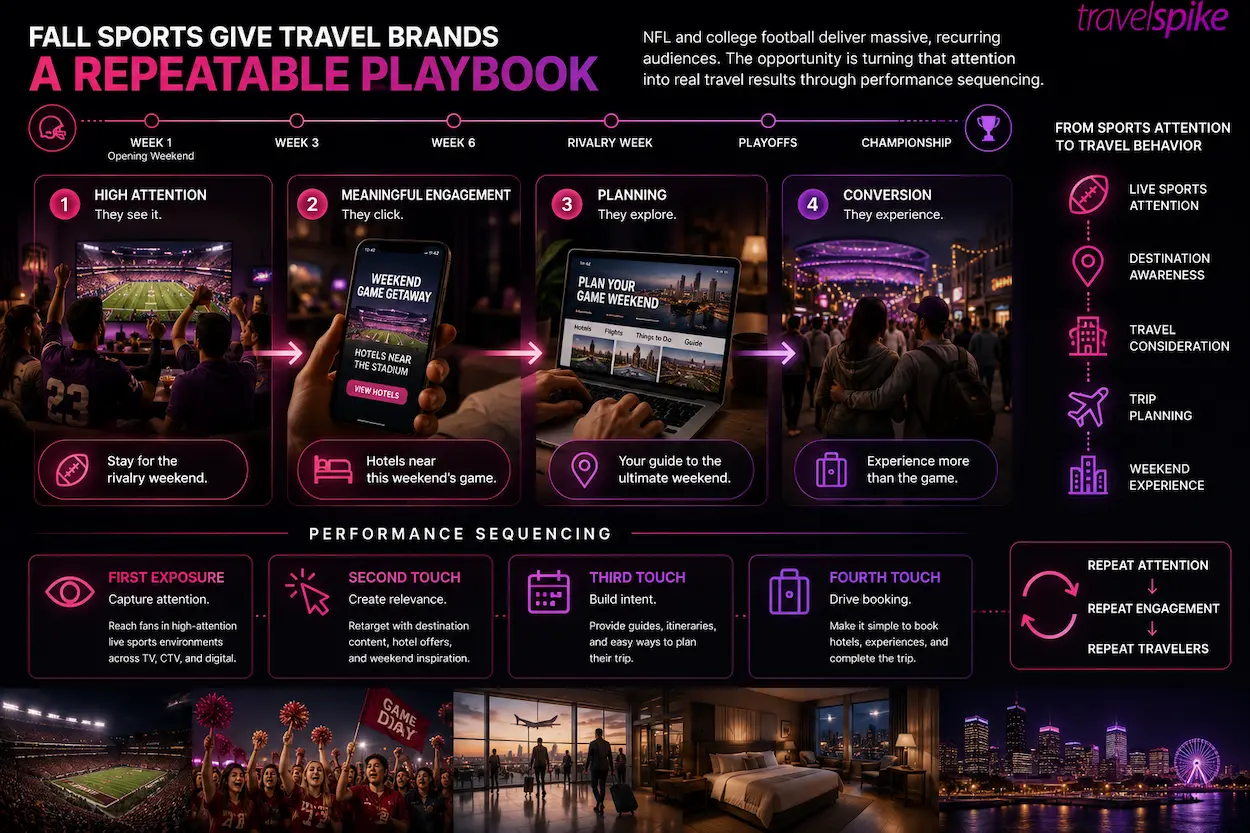
For travel advertisers, fall sports should not be treated as a branding-only environment. Live Sports CTV can support performance because it gives travel brands a way to reach high-attention audiences, then move those audiences into measurable next steps through retargeting, destination content, hotel offers, itinerary pages, or booking paths.
That is where the growth strategy becomes sharper:
- The first exposure builds attention.
- The second touch gives the traveler a reason to engage.
- The third touch moves them toward planning or conversion.
That is not traditional TV thinking. That is performance sequencing.
Travel Brands Should Plan Around Attention Moments
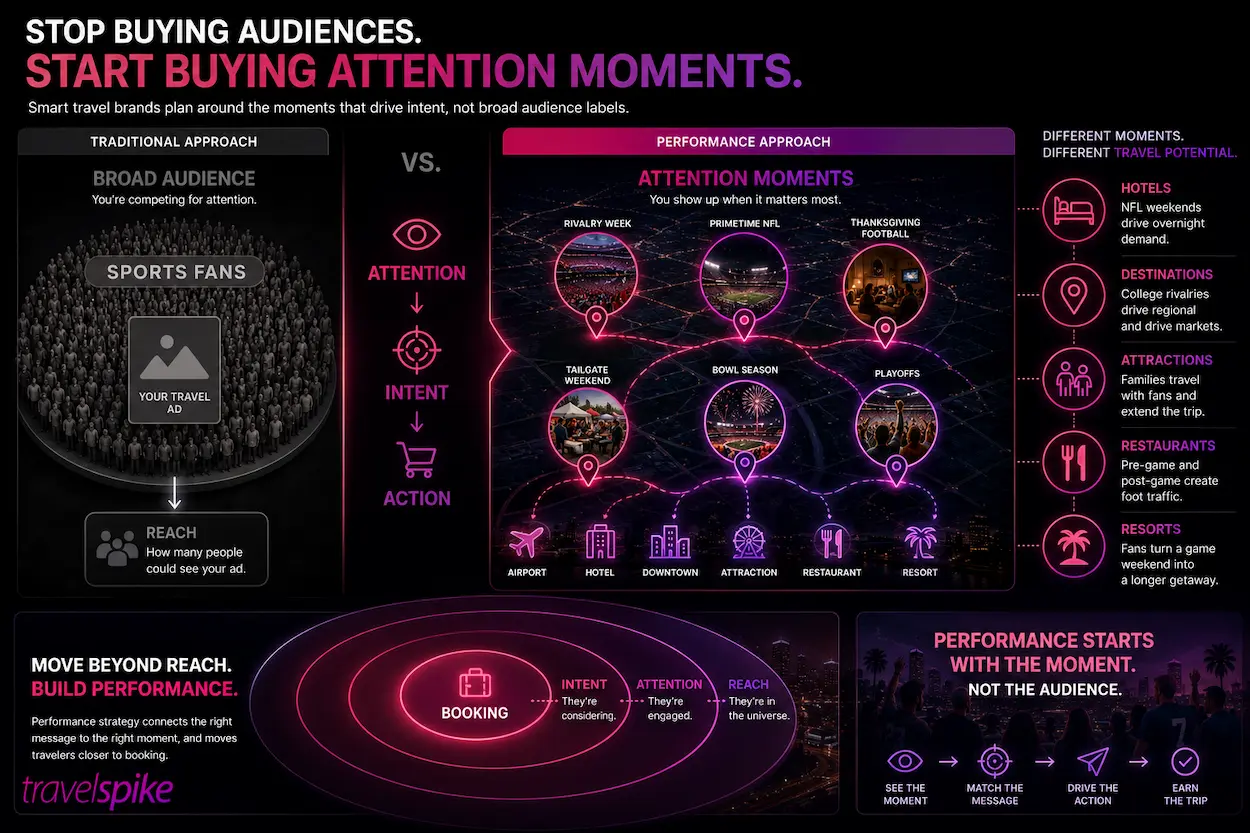
The smartest advertisers will not just buy around “sports fans.” They will plan around attention moments. There is a difference.
A sports fan is a broad audience label. An attention moment is specific. It could be a rivalry game, a primetime NFL matchup, a college football Saturday, a playoff race, a tailgate weekend, a bowl game, or a Thanksgiving football window.
Each of those moments carries different travel potential.
A DMO may care about regional drive markets around college football. A hotel may care about overnight demand around NFL weekends. An attraction may care about families traveling with fans. A restaurant group may care about pre-game and post-game foot traffic. A resort may care about fans who want to turn a game weekend into a longer trip.
This is why media strategy has to move beyond reach.
Reach tells you how many people could see the ad. Performance strategy asks what those people are likely to do next.
The Creative Has to Work Harder
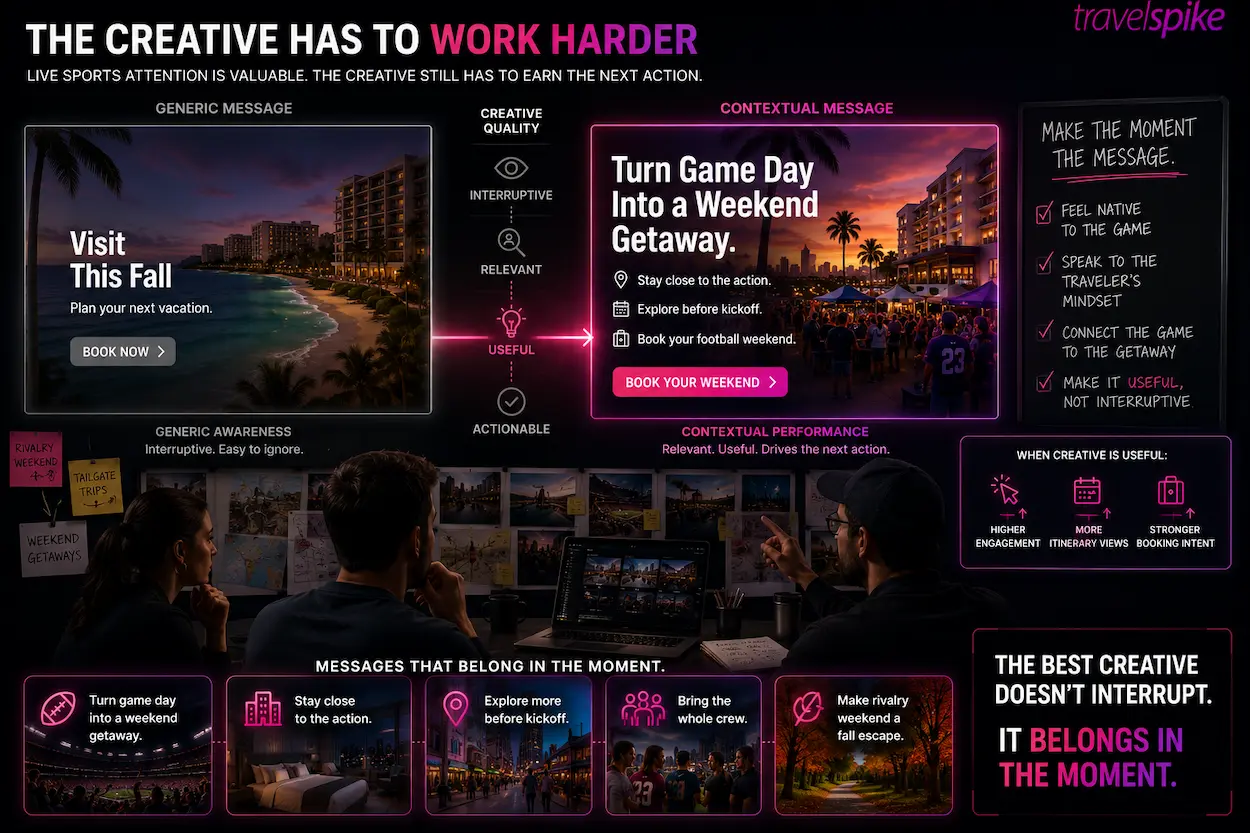
Live sports attention is valuable, but it does not guarantee performance. The creative still has to earn the next action.
Travel advertisers should avoid generic messaging during sports windows. “Visit now” is not enough. “Book your trip” is not enough. The message has to connect the sport moment to the travel use case.
Better creative sounds more like:
- Turn game day into a weekend getaway.
- Stay close to the action.
- Make the rivalry weekend a real trip.
- Explore more before kickoff.
- Bring the whole crew and make it a fall escape.
The message should feel like it belongs in the viewing moment. That is how advertising becomes less interruptive and more useful.
The Takeaway
The World Cup water breaks were created for player welfare, but they also revealed something important about sports media.
When live sports creates more natural attention windows, advertisers get more than extra inventory. They get better moments to connect with audiences while emotion, focus, and intent are active.
For travel brands, that should influence how fall sports campaigns are planned.
The opportunity is not just to appear during NFL or college football. The opportunity is to use Live Sports CTV as part of a performance strategy: capture attention, connect it to a travel reason, retarget based on engagement, and move audiences toward action.
The World Cup showed the value of the pause.
Fall sports will show which travel brands know how to use it.