
AI Is Compressing Travel Discovery. Contextual Travel Ads Help Brands Buy Back Qualified Traffic.
AI is not killing travel demand. It is compressing discovery. That difference matters.
Travelers are still planning trips, comparing destinations, looking for hotels, researching attractions, and deciding where to spend their money. But the way they move through discovery is changing. More answers are being delivered inside AI-powered search results, AI assistants, social feeds, and recommendation environments before travelers ever click through to a brand website.
That creates a performance problem.
If fewer travelers click during the early research stage, travel brands have fewer visible signals to work with. Fewer site visits. Fewer retargeting pools. Fewer content paths. Fewer chances to shape the traveler before the decision is narrowed.
Pew Research Center found that Google users who encountered an AI summary clicked a traditional search result in 8% of visits, compared with 15% of visits when no AI summary appeared. Pew also found that users clicked a link inside the AI summary itself in just 1% of visits.
That is the discovery compression problem. The question is how travel brands pivot?
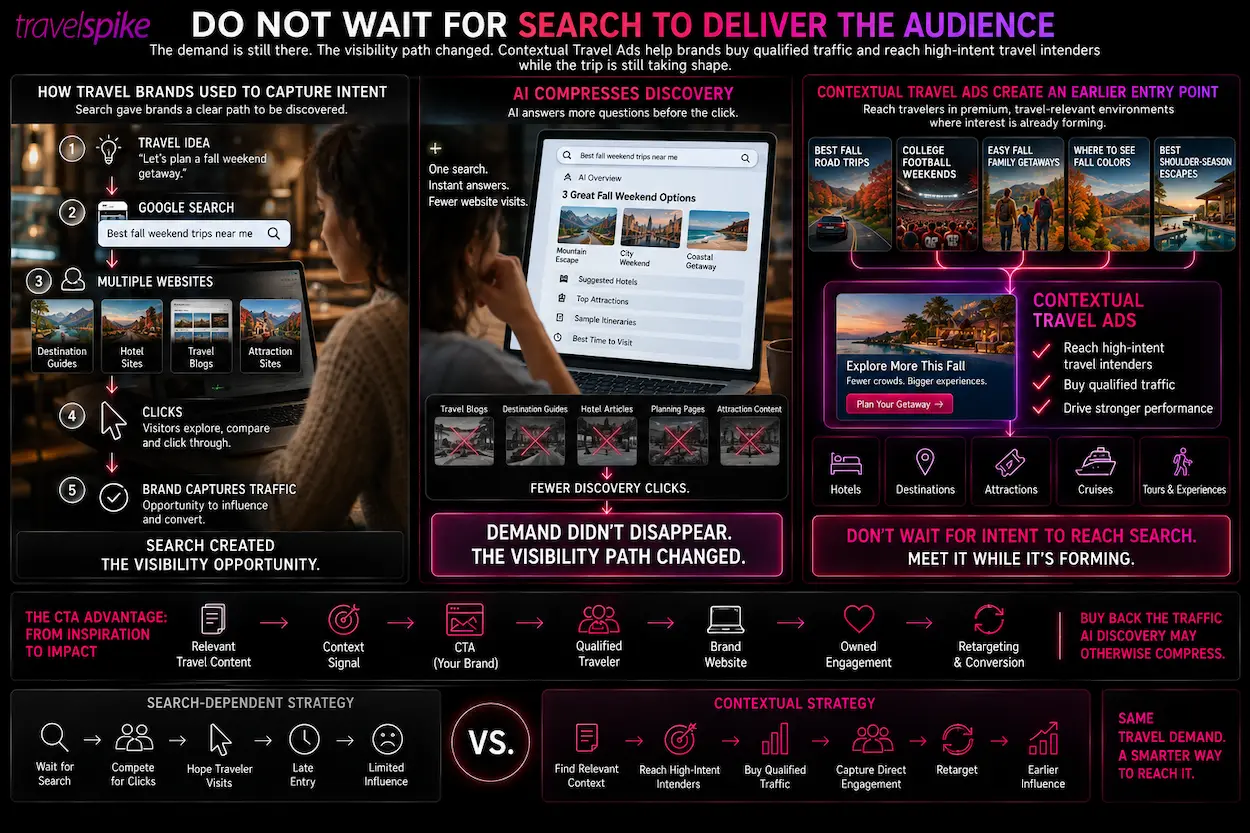
Do Not Wait for Search to Deliver the Audience
For years, travel marketers relied heavily on search behavior as a signal of intent.
But if AI answers more questions before the click, waiting for search becomes riskier. A traveler may ask for “best fall weekend trips near me,” get a summarized answer, compare a few options, and move forward without visiting many destination or hotel websites.
The demand still exists. The visibility path changed.
That is why Contextual Travel Ads (CTA), become more important. CTA gives travel brands a way to buy qualified traffic and reach premium, high-intent travel intenders before they disappear into AI-mediated discovery.
Instead of waiting for the traveler to search and click later, CTA helps brands appear in travel-relevant environments where interest is already forming.
Context Is a Signal
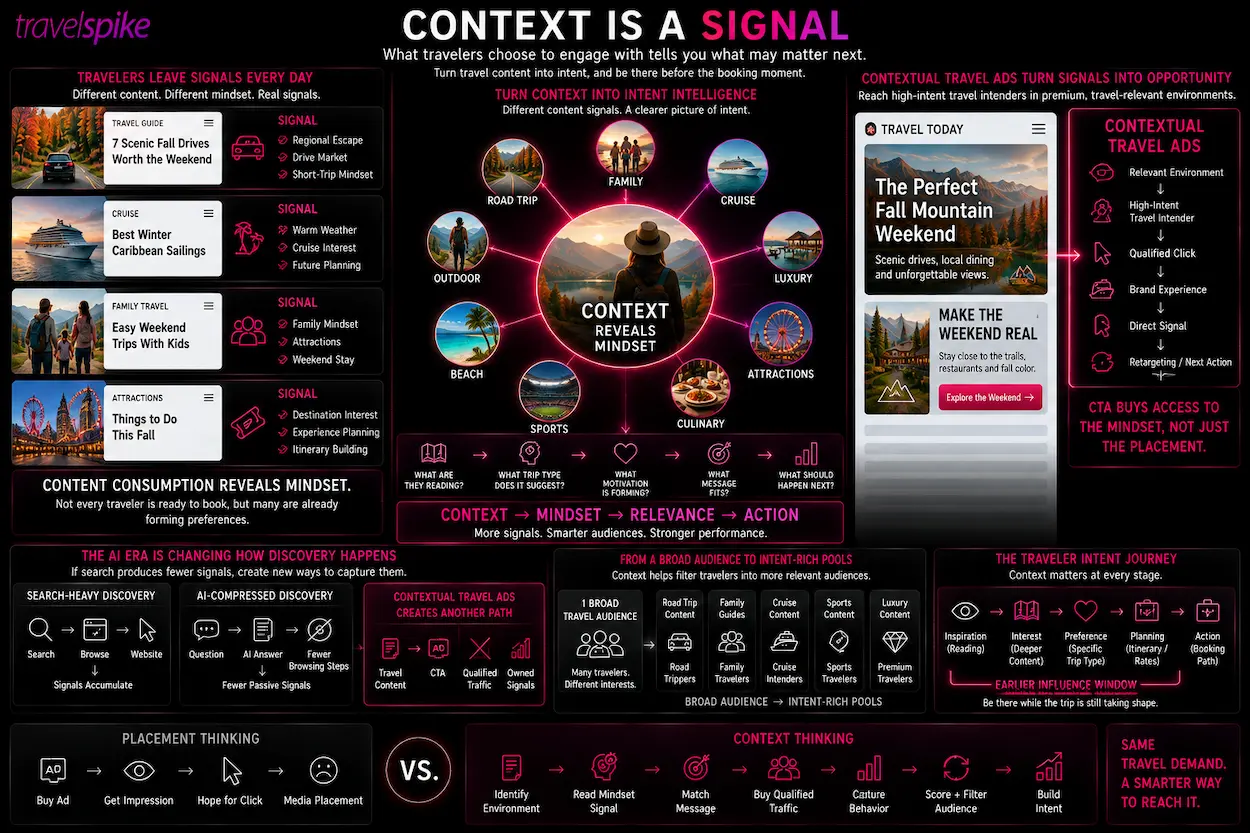
A traveler reading about fall road trips is showing a signal. A traveler engaging with cruise content is showing a signal. A traveler opening travel emails, clicking attraction ideas, reading destination content, or consuming family travel guides is showing a signal.
That context matters because it reveals mindset.
Not every traveler is ready to book, but many are already forming preferences. CTA helps brands get closer to that earlier influence window by placing offers and content in front of audiences already engaging with travel.
This is especially valuable in the AI era because AI may reduce passive browsing from search. Brands need other ways to build traffic, score interest, and filter audiences before the booking moment.
CTA is not just about placement.
It is about buying access to intent-rich travel environments.
Traffic Quality Matters More Than Traffic Volume
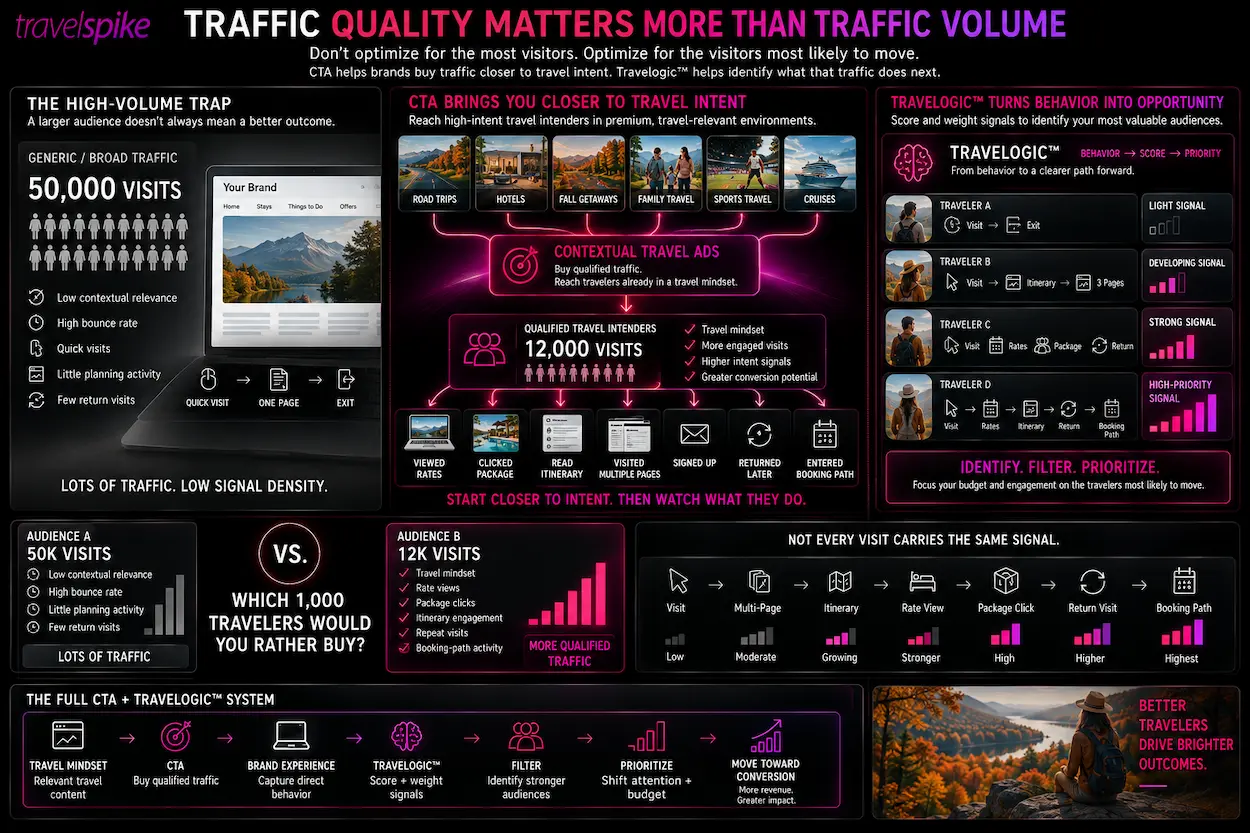
A smaller pool of qualified travel intenders can be more valuable than a larger pool of low-quality impressions.
That is the performance mindset.
The goal is not simply to drive more visits. The goal is to drive visits from people who are already in a travel mindset and then measure what they do next.
- Do they view rates?
- Do they click packages?
- Do they read itineraries?
- Do they visit multiple pages?
- Do they sign up?
- Do they return later?
- Do they enter a booking path?
Those are the signals that matter.
CTA can help travel brands buy traffic that starts closer to intent, while Travelogic™ can help score and weight the resulting behavior so marketers can prioritize the audiences most likely to move.
AI Traffic Is Different, Too
The pivot is not only about defending against AI. It is also about learning from AI-shaped behavior.
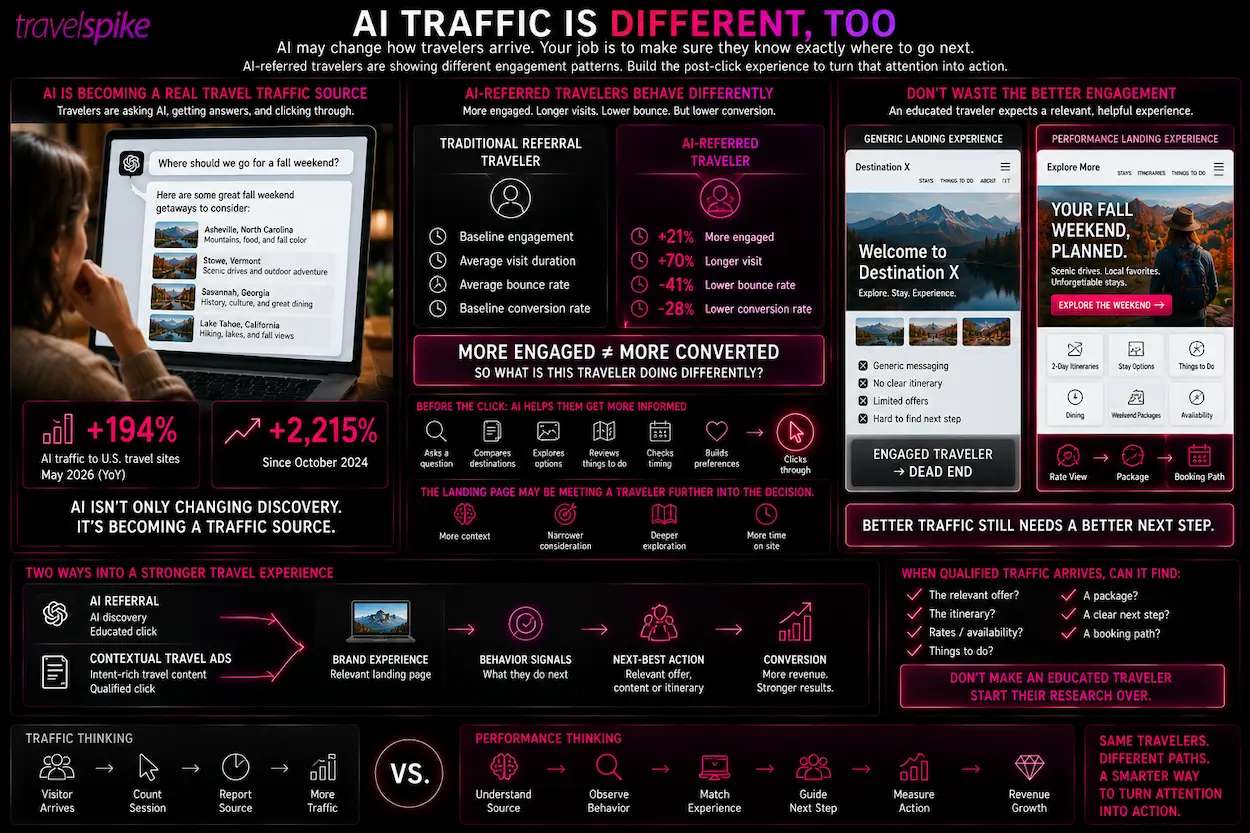
Adobe reported that traffic from AI sources to U.S. travel sites grew 194% year over year in May 2026 and was up 2,215% since October 2024. While AI-driven travel traffic still converted 28% less than non-AI sources, Adobe also found AI-referred travelers were 21% more engaged, spent 70% longer per visit, and had 41% lower bounce rates.
That tells marketers something important.
AI may compress discovery, but when travelers do click through, they may arrive more educated and more purposeful. That makes the landing experience even more important.
CTA can bring qualified travel intenders in. The site then has to convert them with clear offers, relevant itineraries, booking paths, and next-best actions.
The Takeaway
AI is changing the rules of travel discovery.
Travel brands cannot rely only on search traffic to feed the funnel. They need ways to reach travelers before AI narrows the path, before fewer clicks become the norm, and before high-intent audiences are harder to identify.
Contextual Travel Ads give brands a practical way to buy back qualified traffic by reaching premium travel intenders in relevant environments.
The future is not just about ranking higher.
It is about showing up earlier, scoring better signals, and converting the traffic that still matters.