
Performance Marketing for Travel Brands: How to Turn Attention Into Bookings
Travel brands do not need more impressions. They need more travelers taking action.
That is the difference between media activity and performance marketing. In travel, performance is not just about buying clicks, chasing low CPMs, or reporting on traffic volume. It is about building a system that moves people from attention to intent to booking.
That distinction matters because the traveler journey has become more fragmented. People are discovering destinations through AI tools, social video, travel articles, CTV, email, live sports, creators, and recommendations before they ever search or book. By the time a traveler shows clear intent, they have often already been influenced by multiple touchpoints.
For travel brands, the job is not simply to show up at the bottom of the funnel. The job is to perform across the full decision journey.
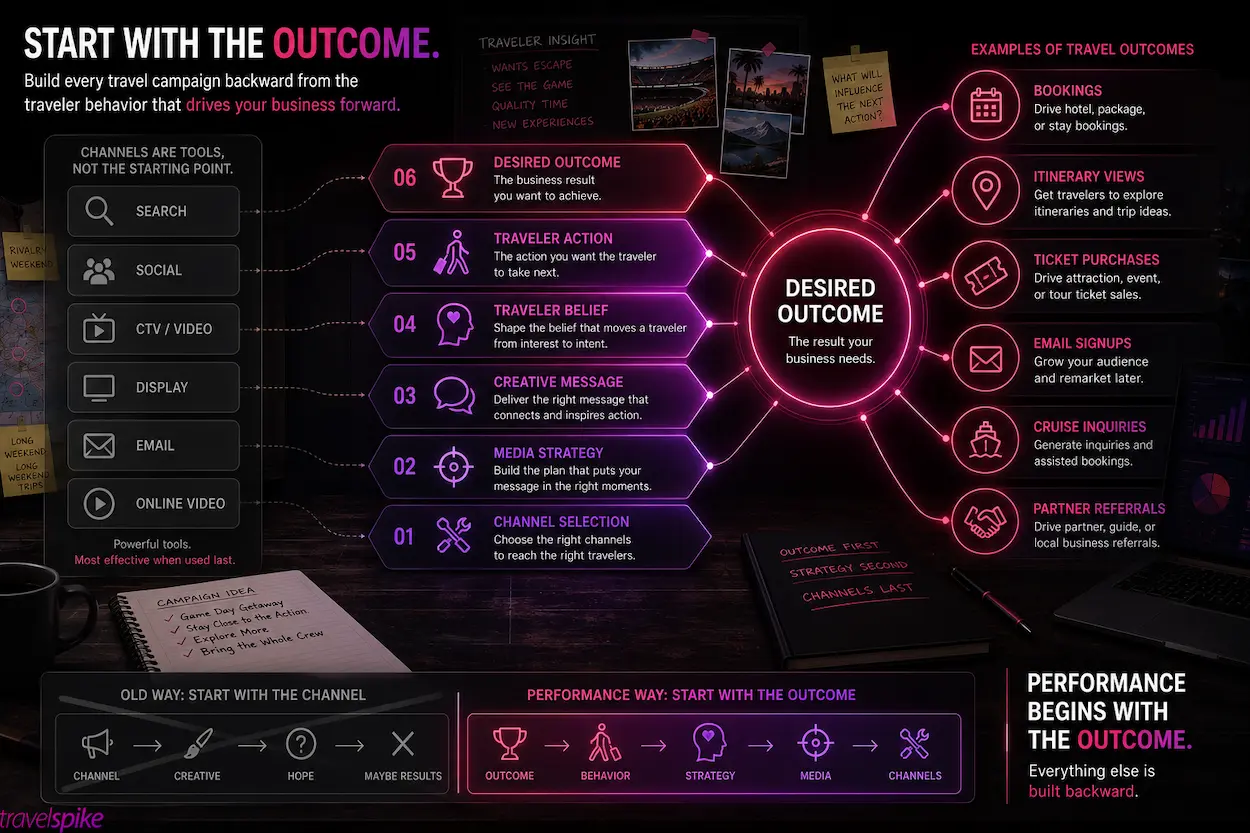
Start With the Outcome
Every travel campaign should begin with a clear action.
That action may be a booking, lead, itinerary view, email signup, package inquiry, ticket purchase, request for proposal, or qualified site visit. The specific conversion depends on the business. A hotel may care about bookings. A DMO may care about guide downloads, itinerary engagement, or partner referrals. An attraction may care about ticket sales. A cruise line may care about inquiries and assisted bookings.
But the principle is the same. Performance marketing should be built backward from the desired traveler behavior.
Too many campaigns start with the channel. Search, social, display, CTV, email. Those are tools. The better question is: what does the traveler need to believe, see, understand, or feel before taking action?
That answer should shape the media plan.
Attention Has to Be Connected to Intent
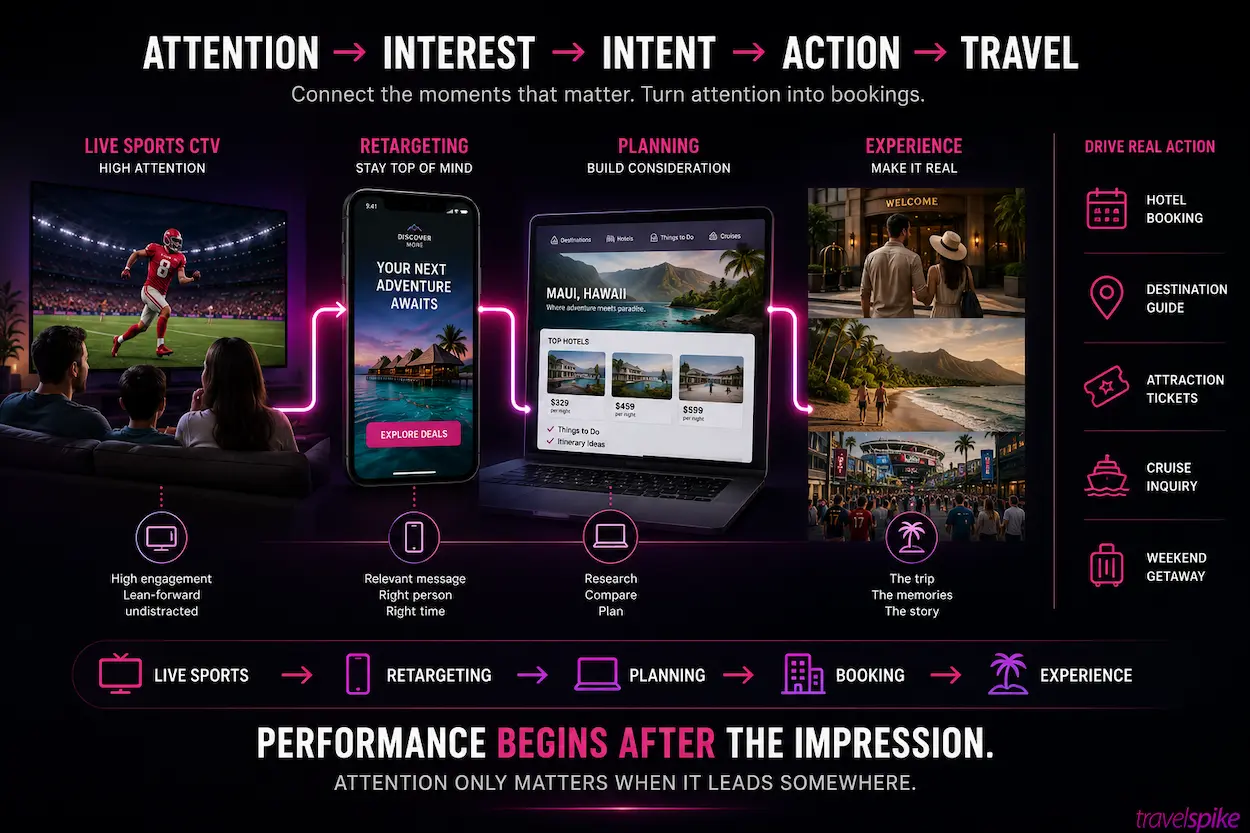
Attention matters, but only when it is connected to the next step.
This is especially important as video and CTV become larger parts of the media mix. According to IAB, U.S. digital video ad spend is projected to surpass $80 billion in 2026, accounting for more than 60% of total TV and video ad spend for the first time.
That growth is happening because video is no longer just an awareness channel. It can drive measurable outcomes when connected to the right audience strategy, sequencing, and retargeting.
For travel brands, Performance CTV for Travel Brands should not be treated like old television. The goal is not only to be seen. The goal is to capture high-attention moments, build emotional interest, and then move those viewers toward trip planning, destination content, hotel offers, attraction tickets, or booking paths.
The performance comes from what happens after the exposure.
Match the Message to the Traveler’s Stage
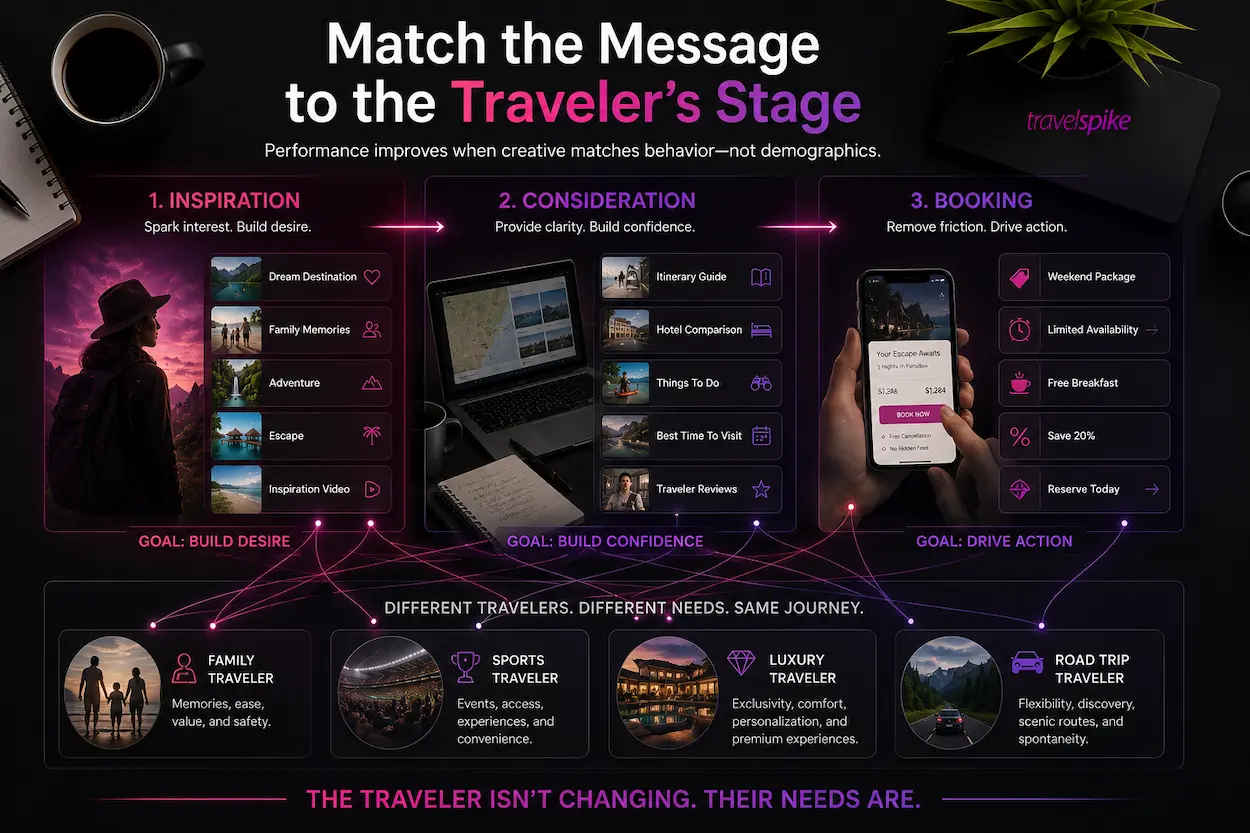
A traveler who just saw a destination video does not need the same message as someone who abandoned a booking page. That is where many campaigns lose efficiency.
Early-stage travelers need inspiration and confidence. Mid-stage travelers need comparison support, itineraries, reasons to go, and proof of value. Late-stage travelers need urgency, availability, pricing, packages, or a clear path to book.
The creative should match the behavior.
A family traveler may need ease and memory-making. A sports traveler may need weekend packages. A luxury traveler may need quality and exclusivity. A road tripper may need convenience. A budget-conscious traveler may need confidence that the trip is worth the spend.
U.S. Travel forecasts domestic leisure travel spending will reach $909 billion in 2026, but also notes travelers are shifting toward shorter-duration and lower-cost trips in response to higher costs. That means performance strategy cannot assume demand is automatic. Travel brands have to prove value.
Use Data to Reduce Waste
Performance marketing is not just about spending more efficiently. It is about wasting less.
Travelogic™ can support that by helping identify where traveler intent is forming, which feeder markets are showing activity, which audience segments are engaging, and where campaigns should be pre-optimized before budget is wasted.
That matters because travel demand is rarely evenly distributed.
One feeder market may be warming up while another softens. One creative theme may drive engagement while another produces empty clicks. One audience may be browsing, while another is ready to act.
Performance strategy requires reading those differences and moving budget accordingly.
The high performing marketers do not wait until the campaign is over to learn. They optimize while there is still time to improve performance.

Context Matters More Than Generic Targeting
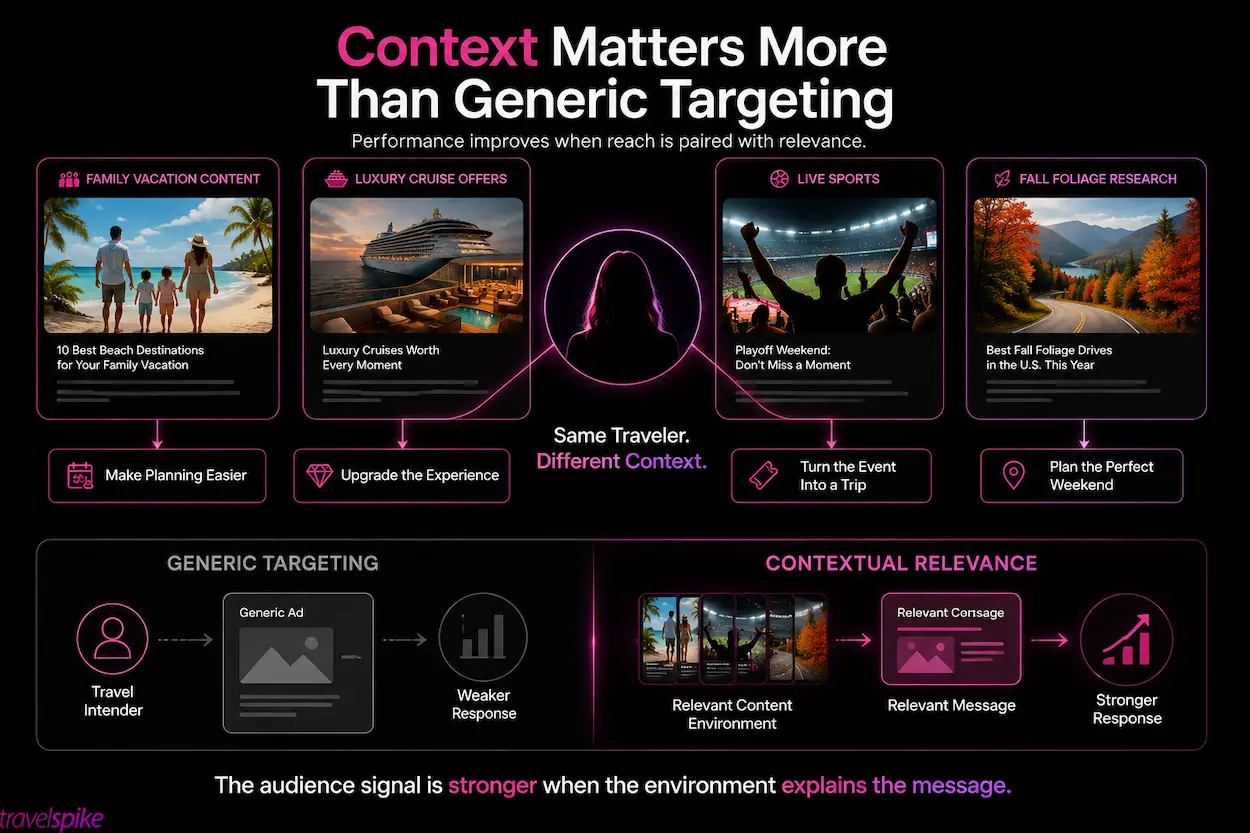
Not all “travel intenders” are equal.
Someone reading family vacation content is not the same as someone engaging with luxury cruise offers. Someone watching live sports may not need the same message as someone researching fall foliage. Someone opening a destination email is giving a different signal than someone scrolling past a social ad.
That is why contextual relevance matters.
Contextual Travel Ads can help travel brands reach audiences inside travel-relevant environments where interest is already forming. The advantage is not simply placement. It is mindset. When the message appears near relevant content, the traveler is more likely to understand why it matters.
This is performance marketing with context, not just reach.
Ask for Better Signals
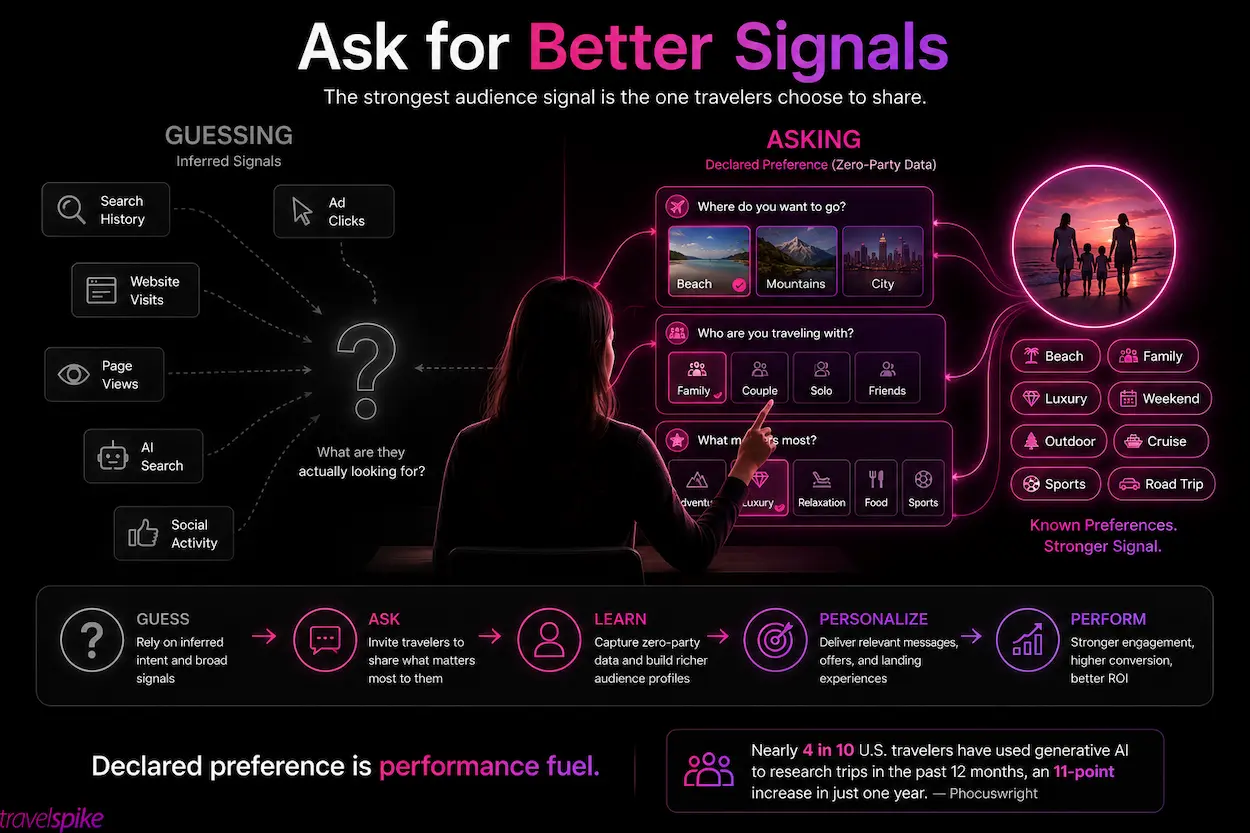
The best performance strategies do not rely only on inferred intent. They create ways for travelers to tell the brand what they want.
Interactive Conversational Ads can help by asking travelers to choose interests, trip types, destinations, activities, or preferences. That zero-party data can then guide follow-up messaging, segmentation, retargeting, and landing page strategy.
This becomes even more important as AI changes discovery.
Phocuswright reports that nearly four in 10 U.S. travelers have used generative AI to research trips in the past 12 months, an 11-percentage-point increase in one year. If travelers are using AI to narrow their options before clicking through to brand websites, travel marketers need stronger direct signals once those travelers engage.
Declared preference is performance fuel.
Measure Quality, Not Just Volume
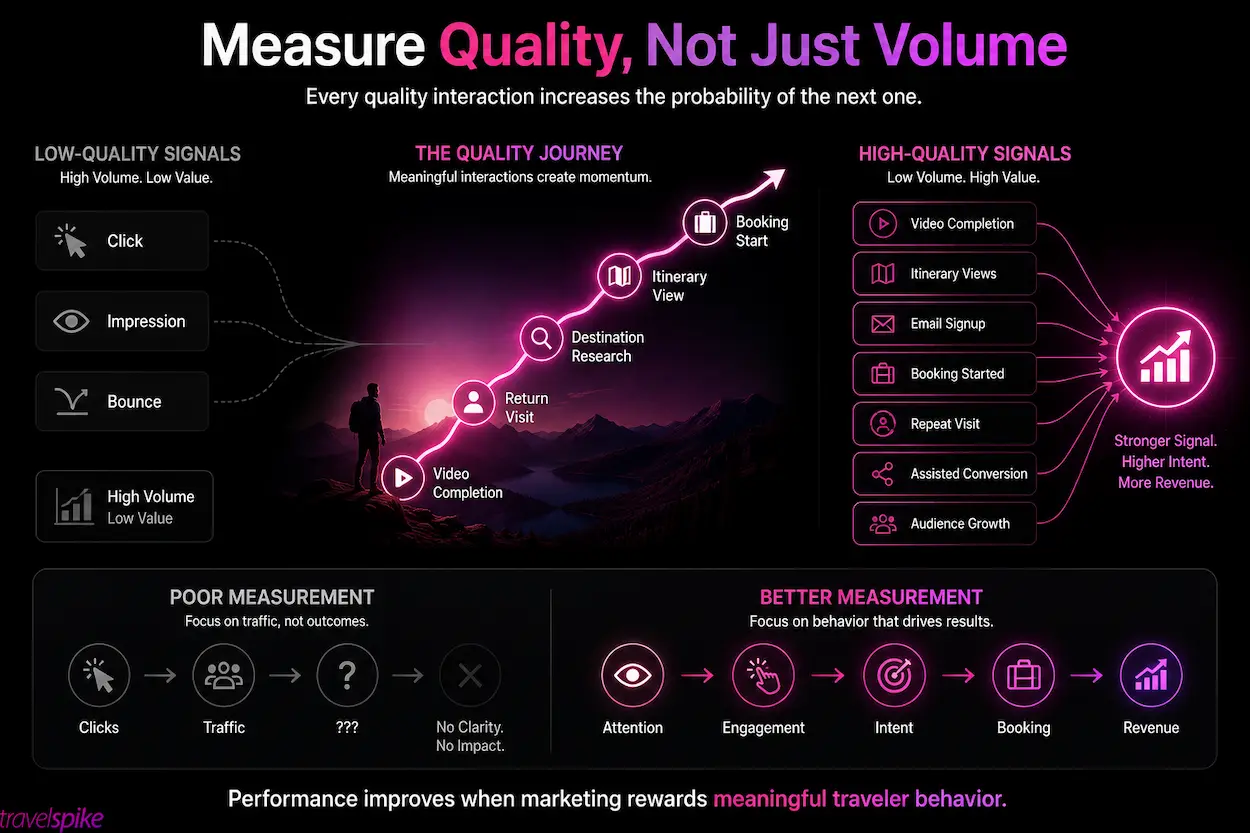
A campaign can generate clicks and still fail. That is why performance marketing needs better measurement than traffic alone.
Travel brands should track engagement depth, return visits, itinerary views, booking starts, assisted conversions, email signups, content paths, video completion, audience growth, and downstream revenue where possible.
The goal is to understand which touchpoints create meaningful traveler movement.
A cheap click that bounces is not performance. A high-attention video view that leads to retargeting engagement, itinerary exploration, and a later booking may be far more valuable.
Performance marketing should reward quality behavior.
The Takeaway
Performance marketing for travel brands is not a single channel. It is a connected system.
It starts with attention, but it cannot stop there. It needs smarter targeting, stronger creative, better data, contextual relevance, retargeting, landing page alignment, and measurement that tracks real traveler action.
The brands that win will not be the ones optimizing only for the cheapest media. They will be the ones building campaigns around how travelers actually decide.
Attention is the starting point. Bookings are the goal.
Everything in between has to perform.