
AI Is Changing Travel Discovery. Travel Brands Need to Own More of the Journey.
AI is changing how travelers discover where to go, what to do, where to stay, and how to plan. That shift is not theoretical anymore.
Google’s AI Overviews are designed to provide AI-generated snapshots in search results, helping users understand information from a range of sources without having to piece everything together manually. Google has also described generative AI in Search as a way to handle planning, brainstorming, and more complex questions, including trip-planning-style use cases.
For travel brands, this creates a strategic problem. If AI tools answer more traveler questions inside the search environment, brands may receive fewer traditional website visits during the research phase.
The traveler may still be interested. They may simply click less.
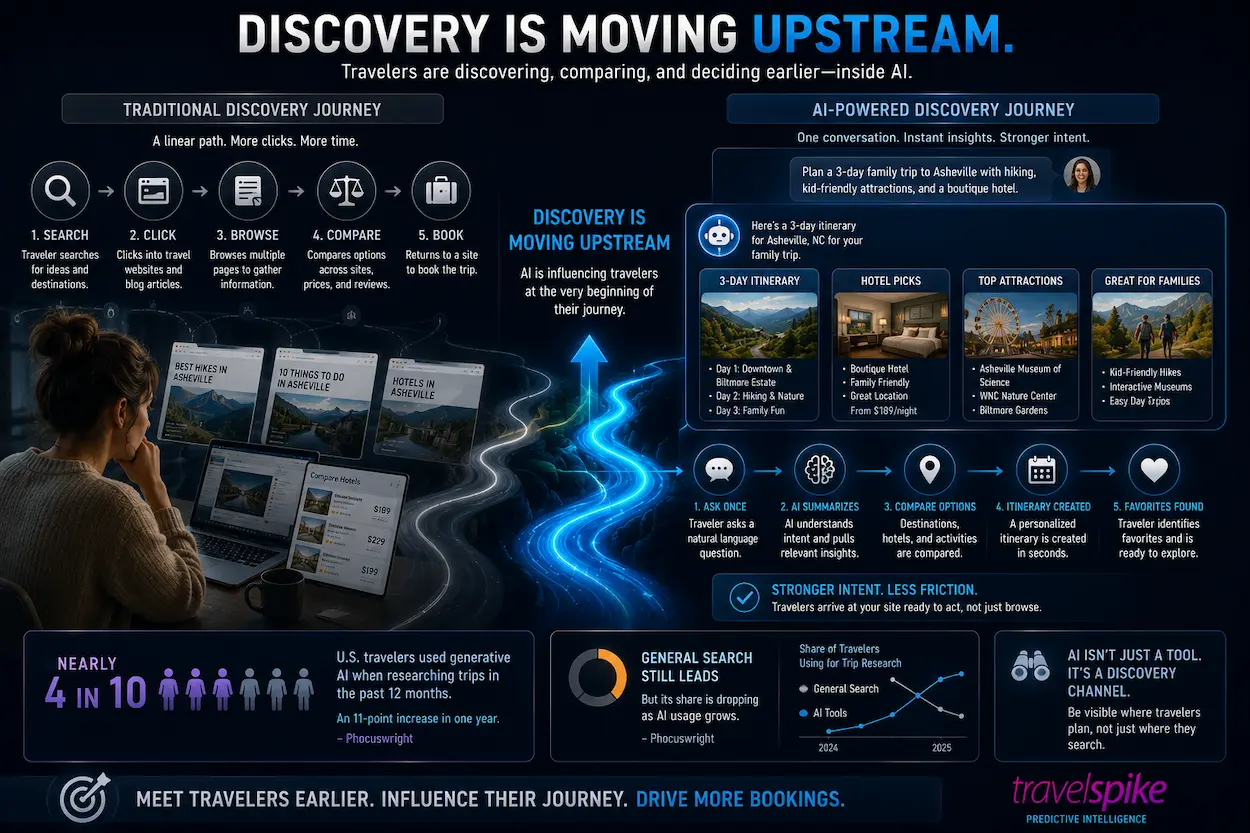
The Discovery Layer Is Moving Upstream
Travel discovery used to be easier to map.
A traveler searched. They clicked. They browsed. They compared. They booked.
That path still exists, but it is no longer the only path.
Now a traveler may ask AI for a three-day itinerary, compare destinations through an answer engine, get hotel recommendations in a summarized result, or ask for family-friendly attractions without clicking through multiple websites.
Phocuswright reports that nearly four in 10 U.S. travelers used generative AI when researching trips in the past 12 months, an 11-point increase in one year. The same research notes that general search still leads, but its share is dropping as AI usage grows.
That means travel brands need to stop thinking of AI as only a content tool.
AI is becoming a discovery channel.
Brands Need More Than Search Visibility
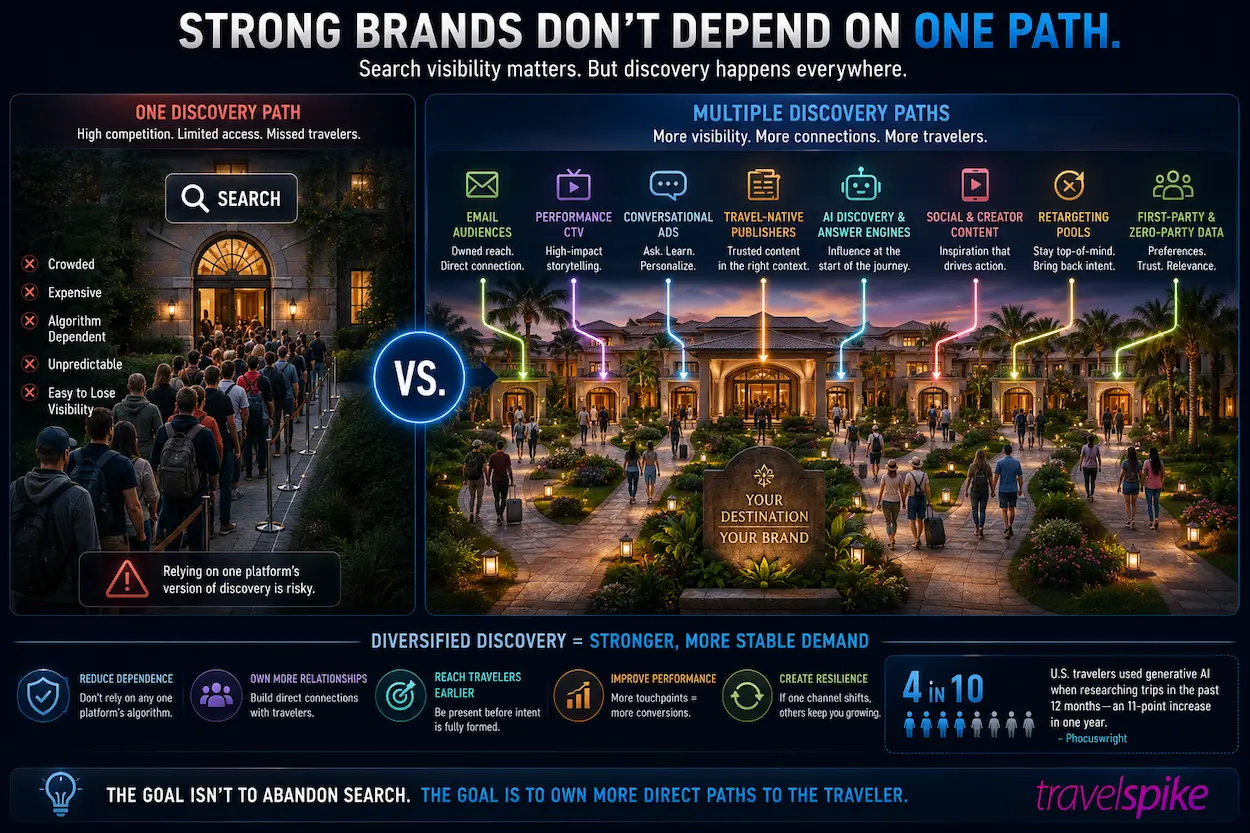
Search visibility still matters. But it cannot be the entire strategy.
If travelers are making decisions from summarized results, AI recommendations, social videos, creator content, CTV exposure, travel emails, and contextual media environments, brands need presence across more of the journey.
That means owning more direct paths to the traveler.
Email audiences. First-party data. Zero-party preferences. Retargeting pools. Content hubs. Travel-native publisher environments. CTV exposure. Conversational tools. Partnerships.
The goal is not to abandon search.
The goal is to reduce dependence on any one platform’s version of discovery.
Content Has to Become More Useful
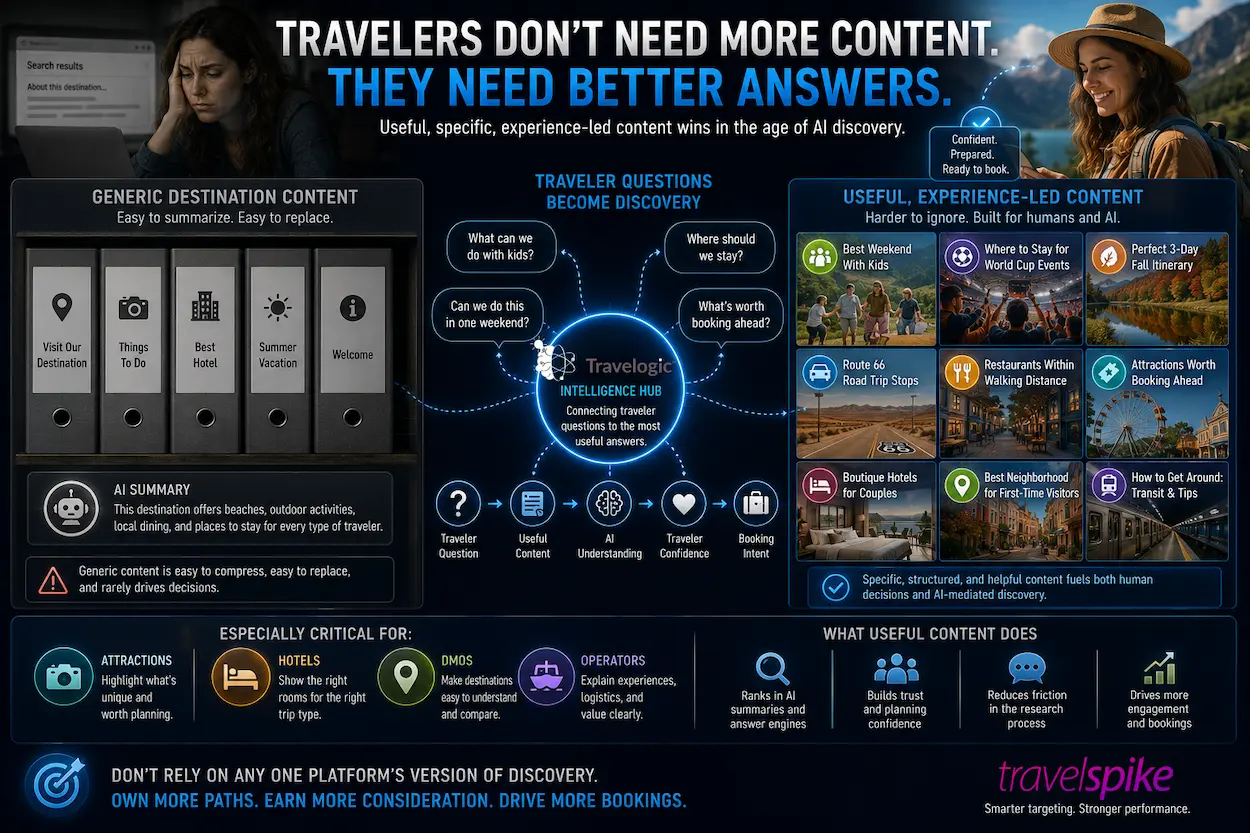
AI raises the bar for content. Generic destination copy is easy to summarize and easy to replace.
Useful, specific, experience-led content is harder to ignore.
Travel brands should build content around real traveler questions: what to do with kids, how to spend a weekend, where to stay for events, what neighborhoods fit different trip types, what experiences are worth planning ahead, and how to combine attractions, dining, lodging, and transportation.
This is especially important for attractions, hotels, DMOs, and operators because AI tools often synthesize recommendations from many sources. The more structured, specific, and useful a brand’s content ecosystem is, the more likely it is to support both human discovery and AI-mediated discovery.
Conversational Data Becomes More Valuable
As discovery becomes more fragmented, brands need better ways to understand what travelers actually want.
This is where Interactive Conversational Ads can play a smart role.
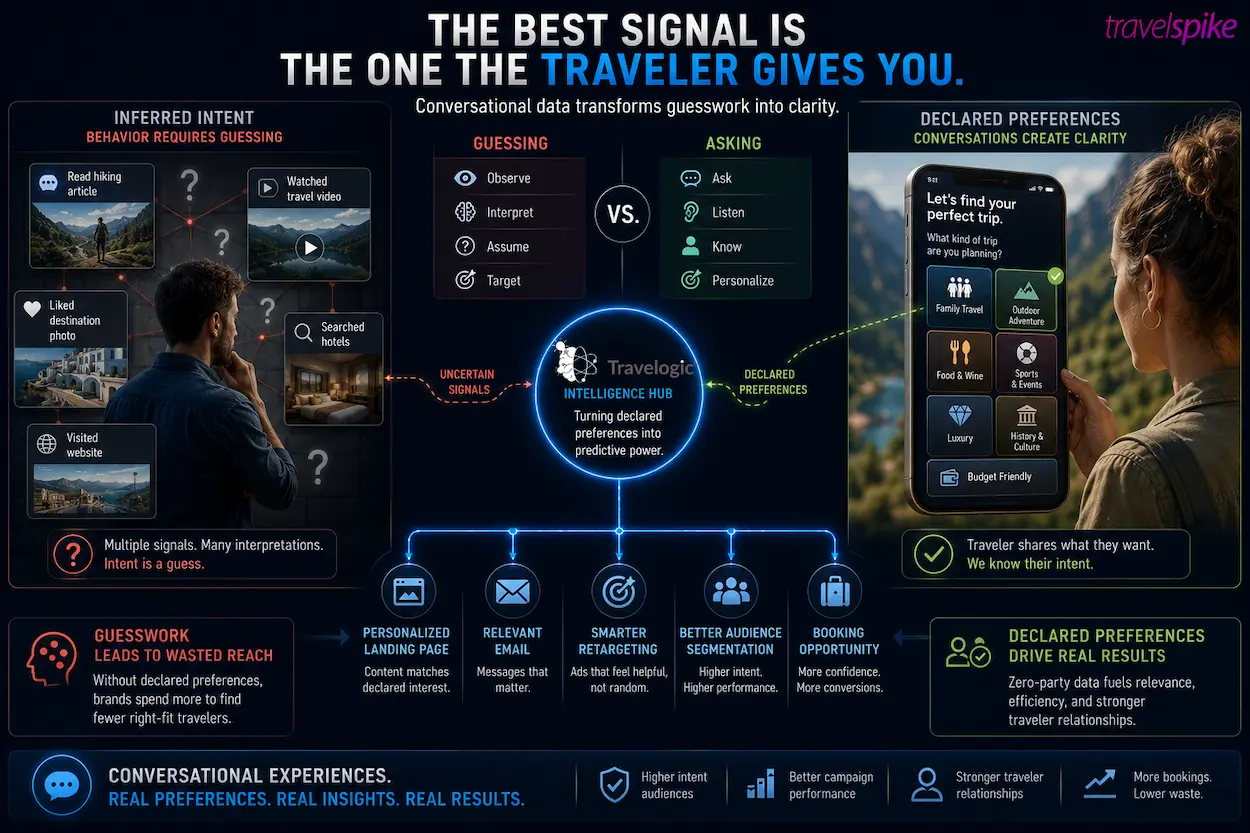
Instead of only pushing one message, conversational formats allow travelers to self-identify interest: family travel, outdoor adventure, food, sports, luxury, events, history, or budget-friendly options. That zero-party data can then inform follow-up messaging, landing pages, retargeting, and audience segmentation.
In an AI-shaped discovery environment, declared preference becomes extremely valuable.
It gives the brand a signal it does not have to infer.
Contextual Travel Media Matters Again
AI may change search behavior, but it does not eliminate travel inspiration.
People will still read travel content, watch travel videos, open travel emails, follow creators, and engage with destination stories.
That is why contextual travel media becomes more important, not less.
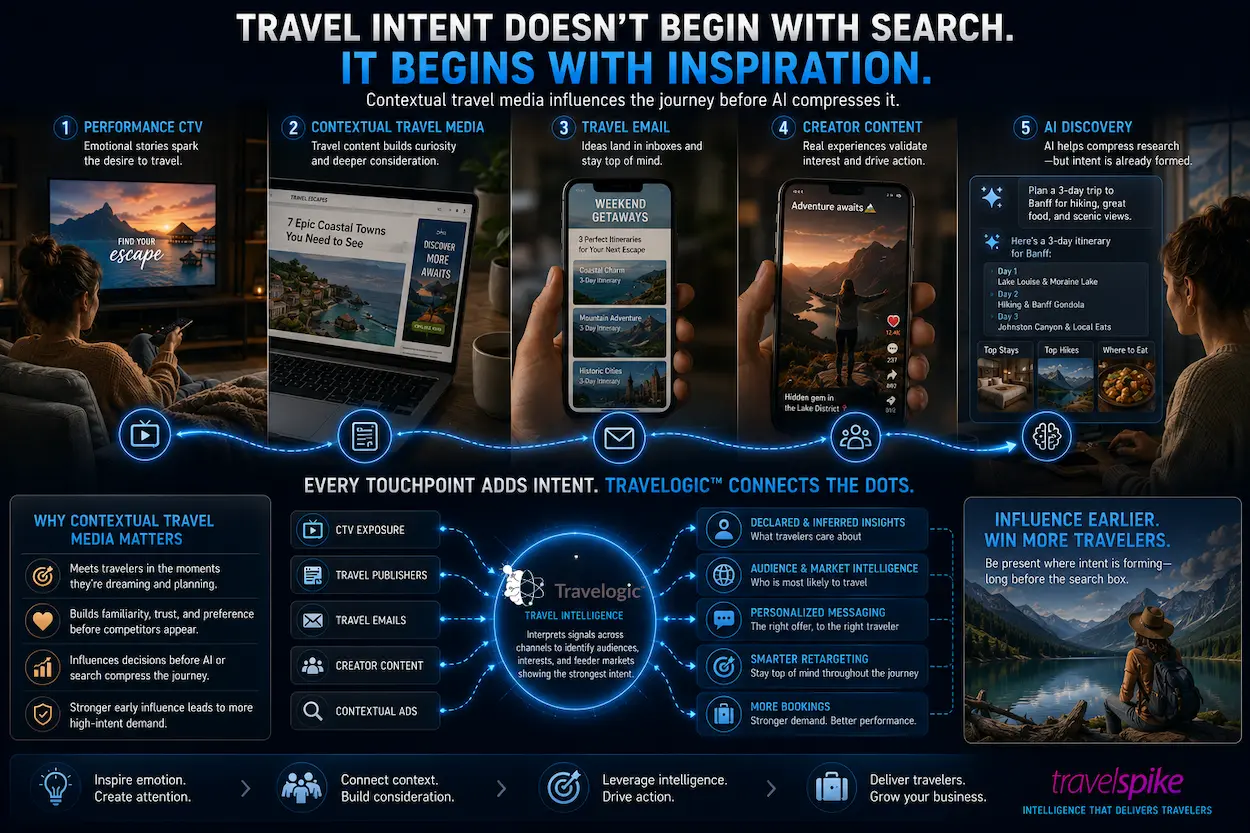
Contextual Travel Ads can help brands appear where travel intent is already forming, even before the search query happens. Performance CTV can create emotional attention. Travelogic™ can help interpret which audiences and feeder markets are showing the strongest signals.
Together, these tools help brands influence the journey before AI compresses it.
The Takeaway
AI is changing travel discovery by moving more planning, comparison, and recommendation activity into answer-driven environments. That does not mean travel brands lose control of the journey.
But it does mean they need to own more of it.
The brands that adapt will build stronger content, stronger direct audiences, stronger contextual presence, and smarter data strategies. They will not wait for the traveler to click.
They will show up earlier, guide better, and give travelers clearer reasons to choose them.