
Spring Break 2026 Is a High-Intent Moment Not Just a Season
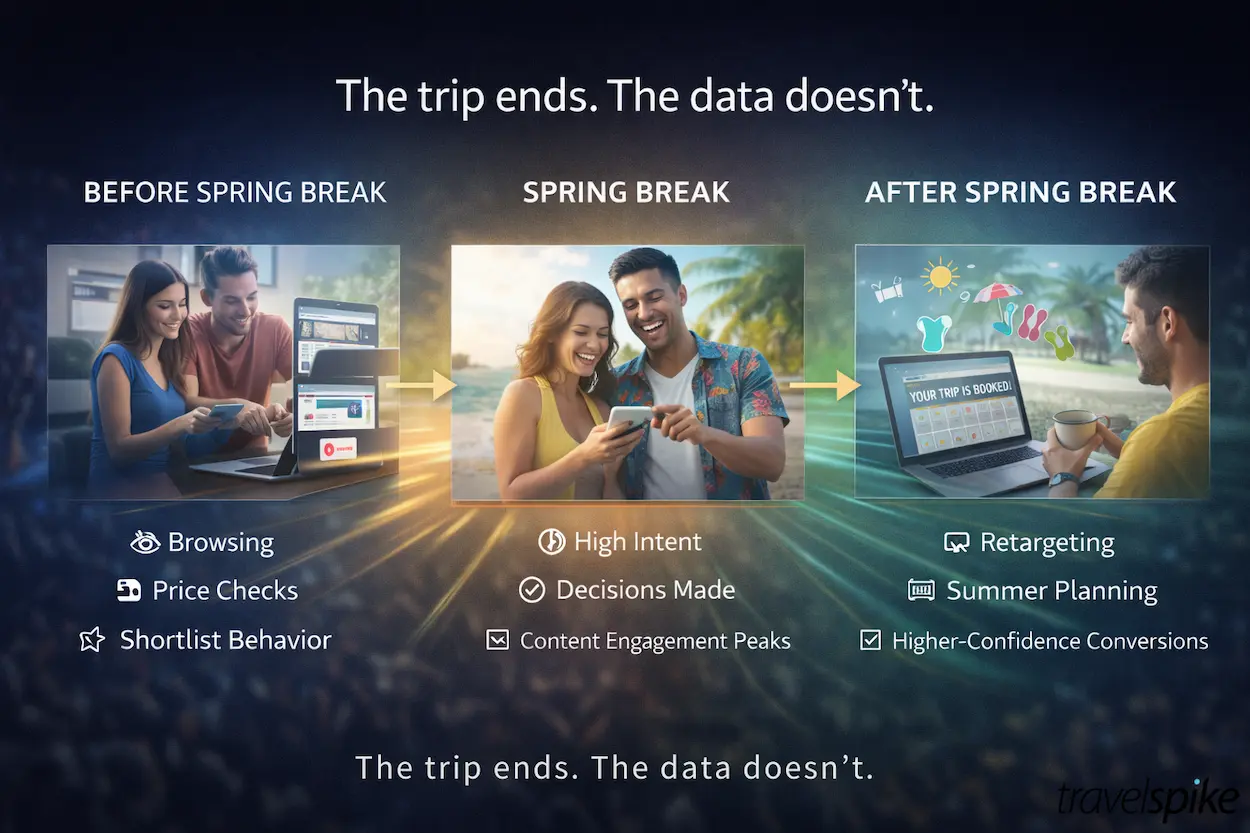
Spring break is often treated like a date on the calendar. But for travel marketers, spring break 2026 is something more valuable: a predictable surge of intent signals that can be captured, modeled, and converted into bookings long after the trip window closes.
That matters because spring break behavior has a halo effect. It reveals:
- what travelers are price-sensitive about,
- what destinations are winning “easy mode” demand,
- what content actually triggers action,
- and what segments are already warming up for summer 2026.
In other words: spring break isn’t just a peak. It’s your best early-year dataset.
Spring break demand is value-driven and “affordable” is the hook
AAA’s spring break content is already framing 2026 around cost-conscious destination choices, emphasizing budget-friendly options and planning strategies.
That aligns with what most travel brands are seeing in-market: travelers still want the trip, but they want it to feel worth it and easy to justify. Your creative should reflect that with messaging like:
- “A break that doesn’t wreck your budget”
- “Direct flights, simple planning, big payoff”
- “3-day reset, 7-day glow-up”
But the real advantage isn’t just pricing. It’s making the decision feel frictionless.
The highest-performing spring break campaigns solve a problem
Spring break travelers often have a specific stressor:
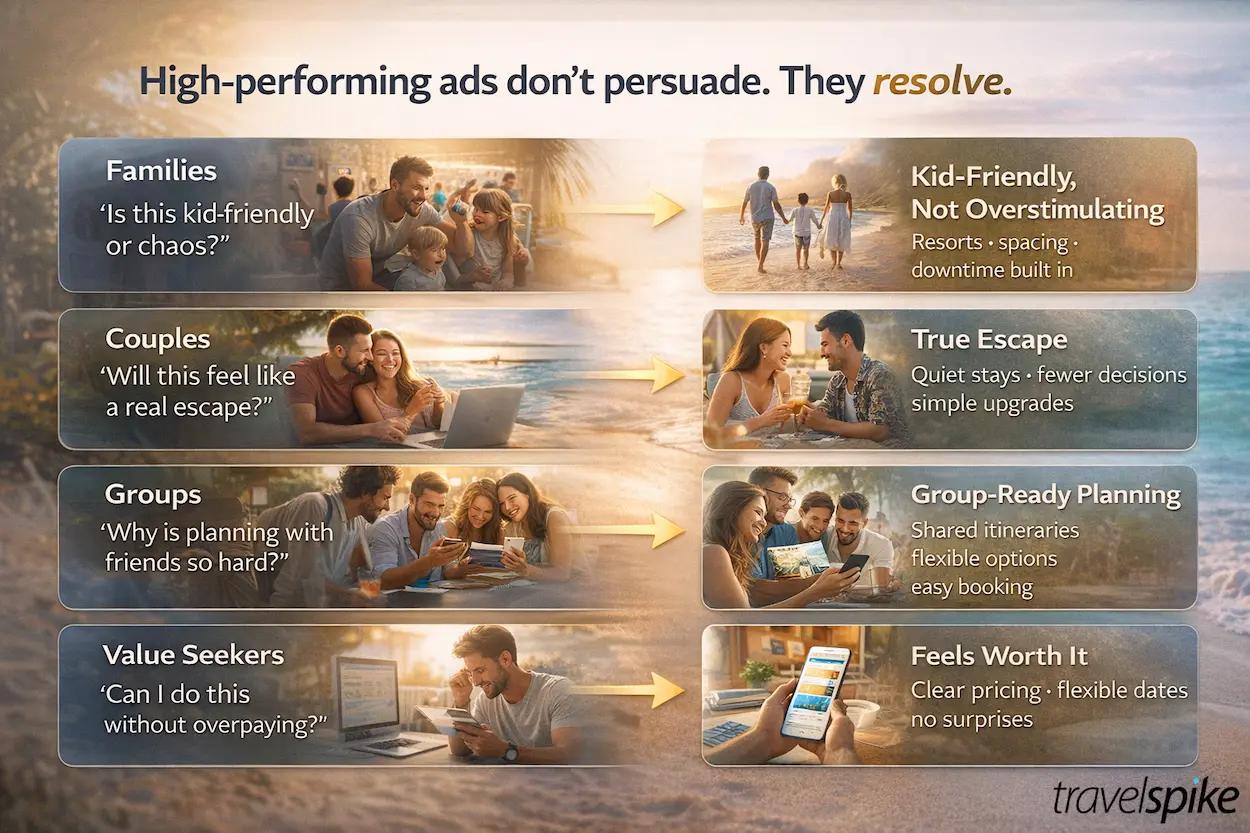
- Families: “Is this kid-friendly and not chaotic?”
- Couples: “Will this feel like a real escape?”
- Groups: “Can we coordinate without it becoming a project?”
- Value seekers: “Can I pull this off without overpaying?”
Your ads win when they behave like answers, not announcements.
A simple creative framework:
- Name the tension (“Spring break planning gets expensive fast.”)
- Offer a simple path (“Here’s the 3-step itinerary that works.”)
- Remove uncertainty (“Flexible dates, clear options, fast checkout.”)
Spring break is where you train your summer algorithm
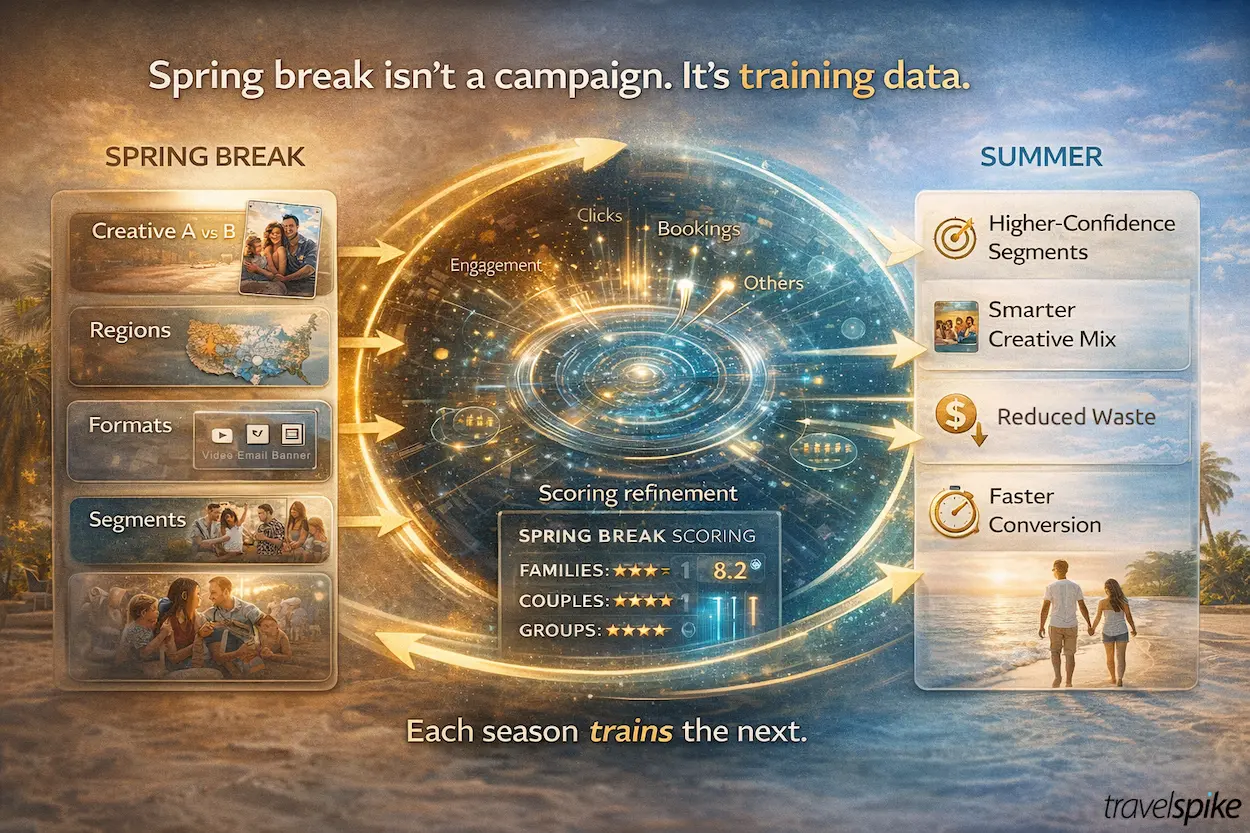
Most marketers treat spring break as “a spring campaign.” Smart marketers treat it as a learning engine for summer.
Here’s what spring break can tell you by segment:
- which audience cohorts convert on experience-first creatives vs value-first creatives,
- which creatives are clicked but don’t convert (attention ≠ bookings),
- which regions are over-saturated (high spend, low lift),
- which content formats actually move mid-funnel behavior.
If you’re using predictive decision tools like Travelogic™, spring break can be used to refine scoring by capturing behavioral patterns that repeat in summer: short-window planners, deal hunters, family trip planners, and “event-driven” travelers.
The point isn’t to overcomplicate it. It’s to build a tighter loop: Signal → Segment → Serve → Scale.
What to do right now: a practical spring break optimization plan
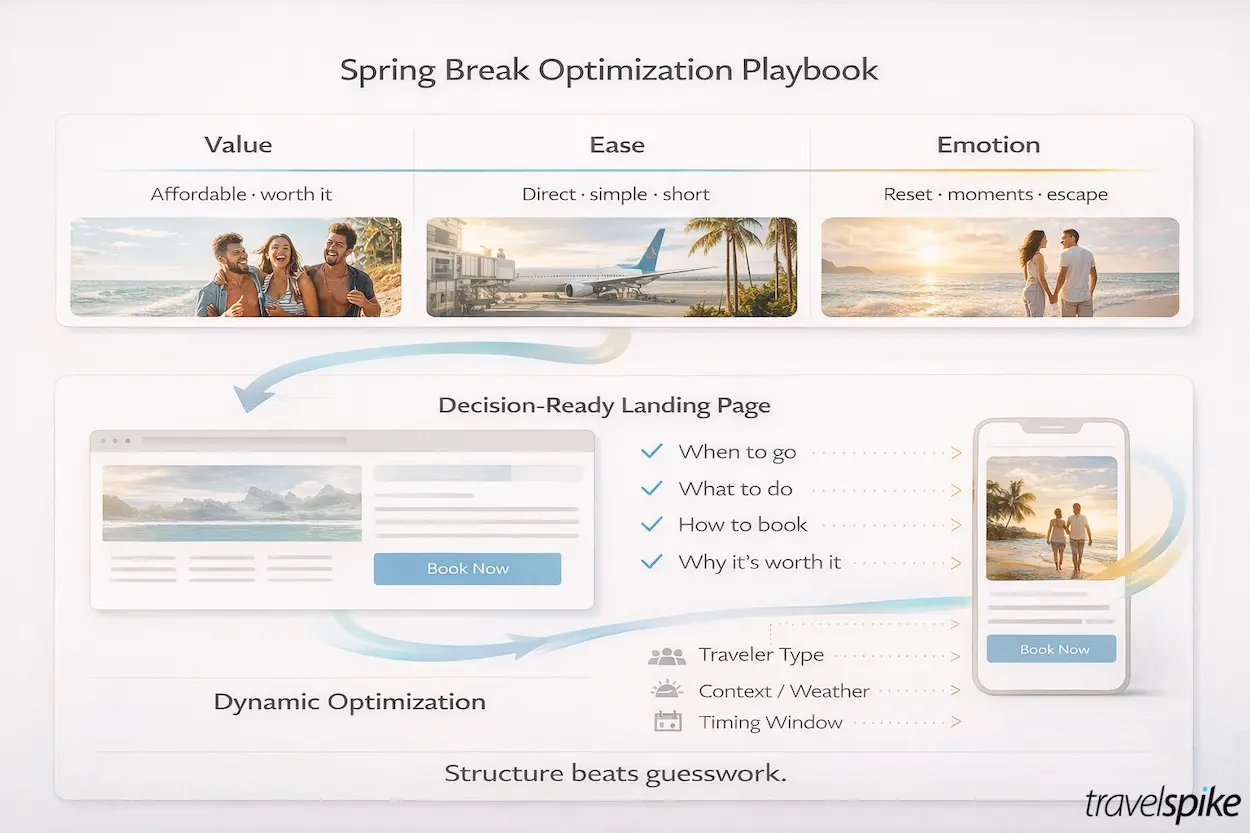
1) Build 3 message lanes
Don’t run one spring break campaign. Run three:
- Value lane: deals, affordability, “under $X” narratives
- Ease lane: direct flights, short itineraries, planning simplicity
- Emotion lane: reset, family moments, “make it feel like a real break”
Rotate creative by lane and let performance tell you what’s real.
2) Make your landing page “decision-ready”
Spring break campaigns often fail not because the ad is weak, but because the landing page doesn’t help travelers decide.
Your landing page should answer quickly:
- when to go,
- what to do,
- how to book,
- why it’s worth it.
3) Use dynamic creative where it counts
Dynamic Creative Optimization (DCO) is built for this exact moment: it adapts ad elements in real time using audience/context signals to deliver more relevant combinations.
For spring break:
- swap imagery by traveler type (family vs couples vs friends),
- swap copy by weather (winter escape vs late-season snow),
- swap CTA by window (book now vs explore dates).
Spring break is also the “early summer” campaign
This year, spring break is the warm-up for a major summer. Between World Cup planning signals and the early build for America250 travel, 2026 will reward brands that show up early, when travelers are still forming their shortlist.
So yes, sell spring break. But also harvest it. Because the brands that win summer 2026 will be the ones who used spring break to learn faster than the competition.