
Co-Op Travel Marketing for Summer 2026: The Most Underused ROI Strategy
Summer 2026 is coming with higher stakes:
- bigger demand,
- bigger competition,
- and in many markets, bigger pricing pressure.
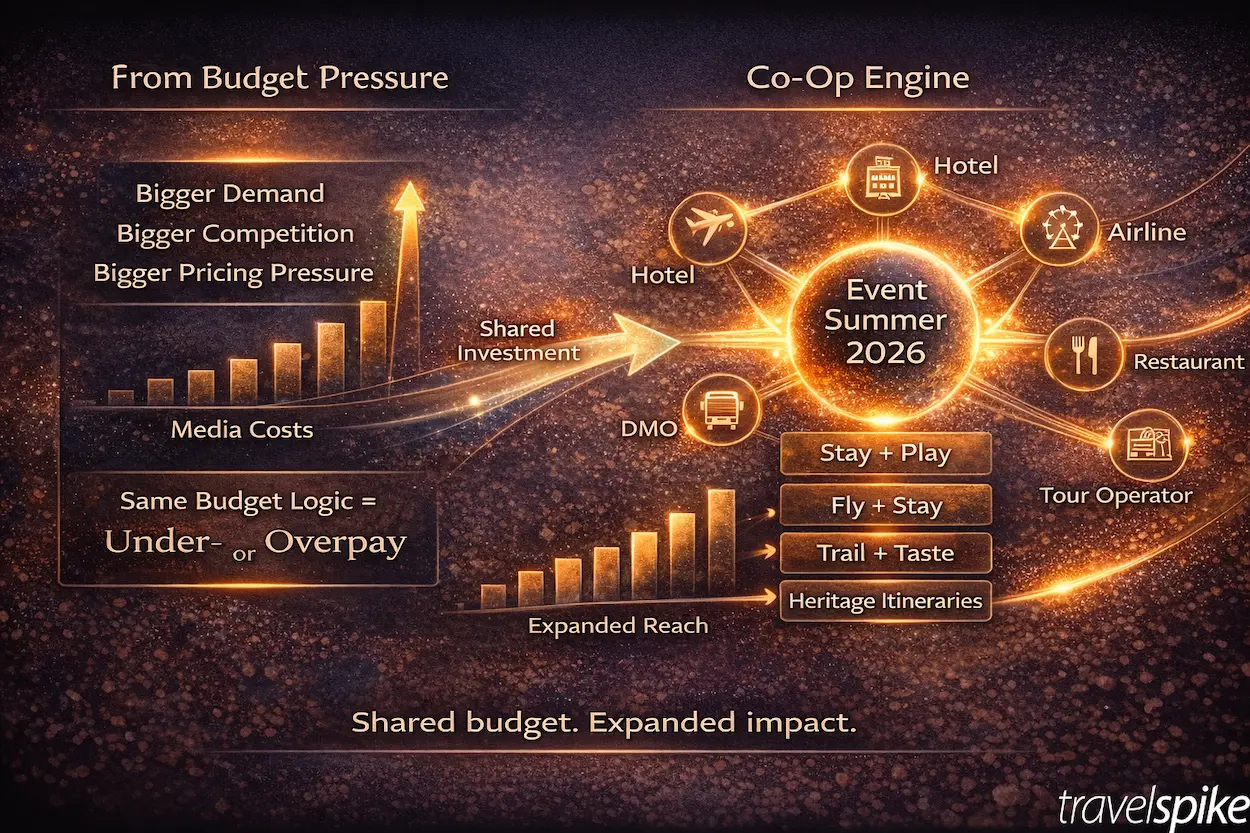
So here’s the uncomfortable truth: if you try to do summer 2026 on the same budget logic as summer 2025, you’ll either under-reach or overpay.
That’s why co-op marketing (and partner-funded campaigns) will quietly become one of the most profitable plays for DMOs, hotels, attractions, and even transportation brands.
Not because co-op is new.
But because 2026’s event calendar makes alignment easier.
Why co-op wins in event-heavy summers
Event summers create natural partner narratives:
- “Stay + Play” bundles (hotel + attraction)
- “Fly + Stay” packages (airline + lodging)
- “Trail + Taste” themes (DMO + restaurants + tours)
- “Heritage itineraries” (America250 storytelling across partners)
America250 content is already emphasizing interactive trails and storytelling activations that often require multi-partner coordination.
Co-op becomes the financial engine that makes those activations scalable.
Common objections and the smarter response
Objection 1: “Co-op takes too long.”
True, if you start in May. But February is the right time to structure it:
- define partner tiers,
- define deliverables,
- create templates,
- and build a ready-to-launch playbook.
Objection 2: “Partners don’t want to pay.”
Often they do, when the offer is clear:
- what they get,
- how it’s measured,
- what it costs,
- what the timeline is.
Objection 3: “We can’t track ROI.”
You can if you build the measurement layer:
- partner landing pages,
- UTM structure,
- conversion events,
- and reporting cadence.
Co-op in 2026 should be performance-designed, not logo-designed
Co-op campaigns fail when they’re just “everyone’s logo on a banner.”
Co-op campaigns win when they’re built like performance media:
- a clear traveler segment,
- a clear problem solved,
- an offer that removes friction,
- and creative that feels like a guide.

How to build a co-op program for summer 2026 (starting now)
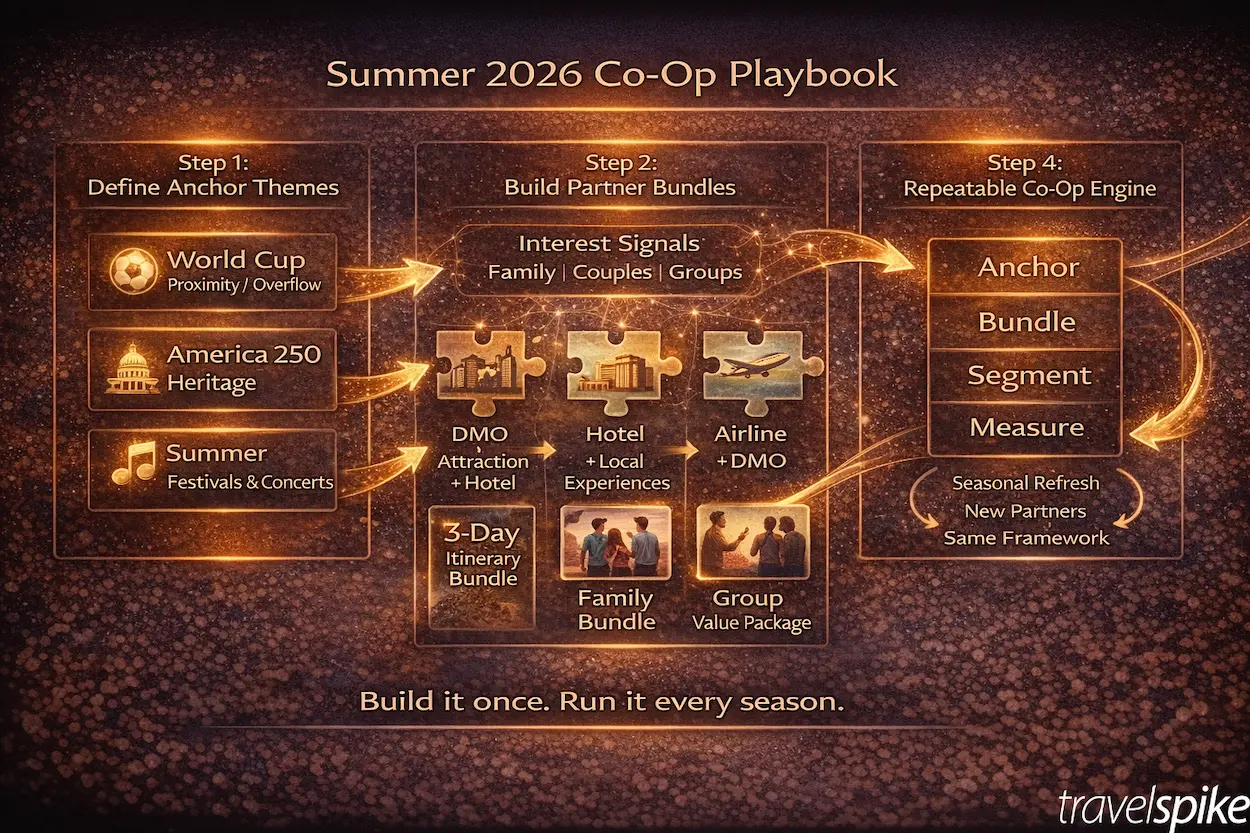
Step 1: Choose your 3 anchor themes
For 2026, your anchors likely include:
- World Cup travel proximity/overflow,
- America250 heritage travel,
- summer festivals/concert moments.
Step 2: Build partner bundles
Examples:
- DMO + attraction + hotel = “3-day itinerary bundle”
- Hotel + local experiences = “curated stay add-ons”
- Airline + DMO = “direct route seasonal push”
Step 3: Use personalization to serve the right bundle
This is where AI-driven segmentation matters:
- families see family-friendly bundles,
- couples see romance itinerary bundles,
- groups see group pricing/value bundles.
Travelogic™ is designed to help identify high-intent audiences based on behavior signals, useful when you want partner dollars to go toward audiences most likely to convert.
Step 4: Build an “always-on co-op template”
Your best co-op program isn’t a one-off.
It’s a repeatable structure you can run every season with new partners.
Summer 2026 is too big to market alone.
But it’s also too big to waste budget on campaigns that don’t convert.
Co-op is the underused middle path: more scale, shared cost, and better ROI, if you design it like performance.